
An Oldie but a Goldie - The Johari Window
It can be argued that great leadership rests on the shoulders of self-awareness. Most managers understand this in theory, they know they should be aware of their communication style, their impact on others, their strengths, their blind spots and the way they show up under pressure.
But pure self reflection has a limit. We cannot fully understand our strengths, development needs and leadership impact by looking inwards. We need feedback from others. This is where the Johari Window remains a simple but powerful tool for modern managers and leaders.
What is the Johari Window?
The Johari Window is a model that helps people understand the relationship between self-awareness and how they are perceived by others.
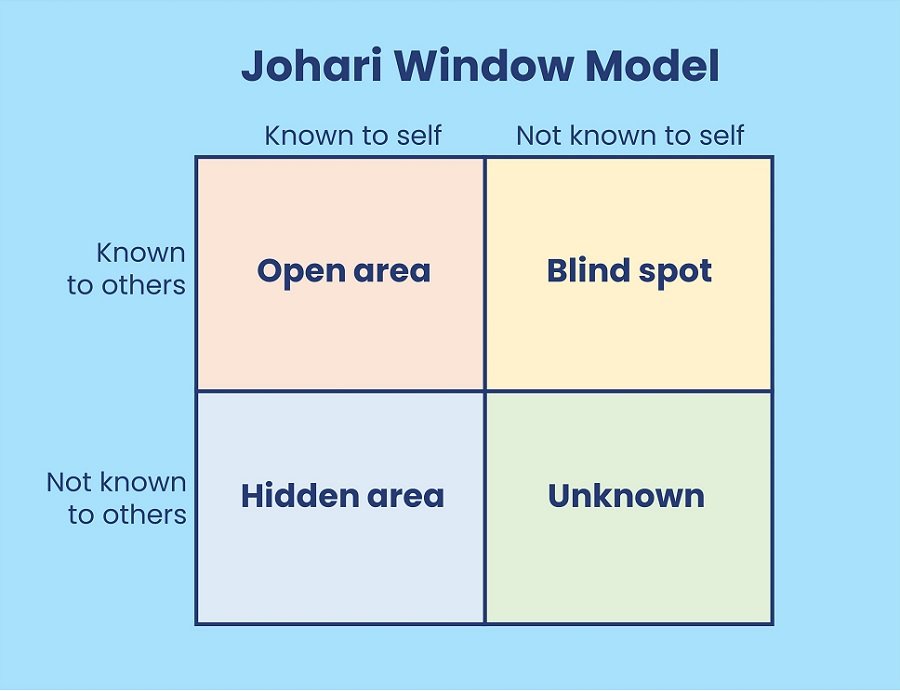
It is usually shown as four areas:
Open area:
What you know about yourself and others also know about you.
Blind spot:
What others see in you, but you do not see in yourself.
Hidden area:
What you know about yourself but have not shared with others.
Unknown area:
What is not yet known by you or by others.
For leaders, the most valuable part of the model is often the blind spot. This is where feedback becomes essential.
Why the Johari Window still matters today
Modern workplaces are more complex, fast-moving and relationship-driven than ever. Leaders are expected to manage change, build trust, support wellbeing, create inclusive teams and make good decisions under pressure.
Technical skill is no longer enough.
A leader’s effectiveness is shaped by how they communicate, listen, respond to challenge, handle conflict and create psychological safety. These behaviours are not always easy to judge from our own perspective.
A manager may believe they are being clear, while their team experiences them as abrupt.
A leader may think they are giving people autonomy, while others feel unsupported.
Someone may see themselves as calm and considered, while their team sees them as distant or unavailable.
These gaps between intention and impact are exactly what the Johari Window helps reveal.
Feedback expands the open area
The goal of the Johari Window is not to expose people or make them uncomfortable. It is to increase the open area, the space where both the leader and those around them have a shared understanding.
When leaders receive honest feedback, they learn more about their impact. When they share more openly, others understand their thinking, values and intentions more clearly.
This creates better working relationships.
Teams do not need perfect leaders. They need leaders who are willing to listen, learn and adjust.
Feedback helps leaders see their blind spots
Every leader has blind spots. That is not a weakness. It is part of being human.
The problem is not having blind spots. The problem is refusing to look for them.
Feedback helps managers and leaders identify patterns they may not notice on their own, such as:
Interrupting others without realising it
Avoiding difficult conversations
Favouring certain voices in meetings
Giving unclear direction
Becoming defensive when challenged
Underestimating the effect of their mood on the team
Failing to recognise effort or progress
Small behaviours can have a large impact, especially when they come from someone in a position of authority. A passing comment from a senior leader can shape confidence, trust and motivation more than they realise.
The Johari Window gives leaders a practical way to understand that leadership is not just about what they intend. It is also about what others experience.
Modern feedback needs to be continuous
In the past, feedback was often tied to annual reviews or formal performance processes. That is no longer enough.
Modern leadership requires feedback to be more regular, specific and two-way.
Managers need to ask questions like:
“What am I doing that helps you do your best work?”
“What could I do differently to support the team?”
“Where could my communication be clearer?”
“Are there any decisions or behaviours that are creating confusion?”
“What do you need more or less of from me?”
These questions help make feedback normal rather than threatening. They also show the team that feedback is not just something leaders give to others. It is something leaders seek for themselves.
Feedback builds trust when leaders act on it
Asking for feedback is important. Acting on it is even more important.
If a leader asks for input but becomes defensive, dismisses what they hear or does nothing with it, trust can be damaged. People quickly learn whether feedback is genuinely welcome or only requested for appearance.
Leaders do not need to agree with every piece of feedback. But they do need to listen carefully, look for patterns and respond with maturity.
A simple response can be powerful:
“Thank you for telling me. I had not realised that was how it was landing.”
“I can see how that created confusion. I will be clearer next time.”
“That is useful feedback. I need to reflect on it.”
These moments matter. They show humility, accountability and respect.
The hidden area matters too
The Johari Window is not only about receiving feedback. It is also about appropriate self-disclosure.
Leaders often keep their thinking hidden. They may assume people understand why a decision was made, why priorities have changed or why certain issues are sensitive. But when leaders do not share enough context, teams can fill the gaps with uncertainty or assumptions.
Expanding the open area means communicating more clearly and intentionally. This might include explaining the reason behind a decision, naming what is still uncertain or being honest about competing priorities.
This does not mean oversharing or placing emotional burden on the team. It means giving people enough information to understand, contribute and trust the process.
Using the Johari Window in leadership development
The Johari Window can be used in practical ways across leadership development, coaching and team effectiveness work.
It can help leaders reflect on:
How they believe they show up
How others experience them
What they tend to keep hidden
Where they may need more feedback
What behaviours they need to adjust
How they can create more openness in the team
It can also support 360-degree feedback, engagement survey debriefs, team workshops and one-on-one coaching conversations.
The value of the model is its simplicity. It gives people a shared language for talking about awareness, feedback and trust without making the conversation overly complicated.
Great leaders make feedback safe
For feedback to work, people need to feel safe enough to be honest.
This is where managers and leaders play a critical role. They set the tone. If they punish honesty, avoid difficult conversations or react poorly to challenge, feedback disappears. People may still have views, but they will share them elsewhere, or not at all.
A feedback-rich culture starts with leaders who can receive feedback well.
That means listening before responding. Asking clarifying questions. Thanking people for their honesty. Looking for truth, even when the message is uncomfortable.
It also means giving feedback to others with care and clarity. Feedback should not be vague, personal or saved up until frustration builds. It should be timely, behaviour-based and focused on growth.
The real power of the Johari Window
The Johari Window remains relevant because it reminds us of a simple truth: leadership happens in relationship with others.
A manager may have a clear view of their own intentions, but leadership effectiveness is measured through impact. Feedback helps close the gap between the two.
For modern leaders, this is not optional. It is central to building trust, improving performance and creating healthier teams.
The leaders who grow the most are not the ones who assume they already know themselves. They are the ones who keep asking, listening and learning.
Because the more we understand our impact, the better we can lead.
